
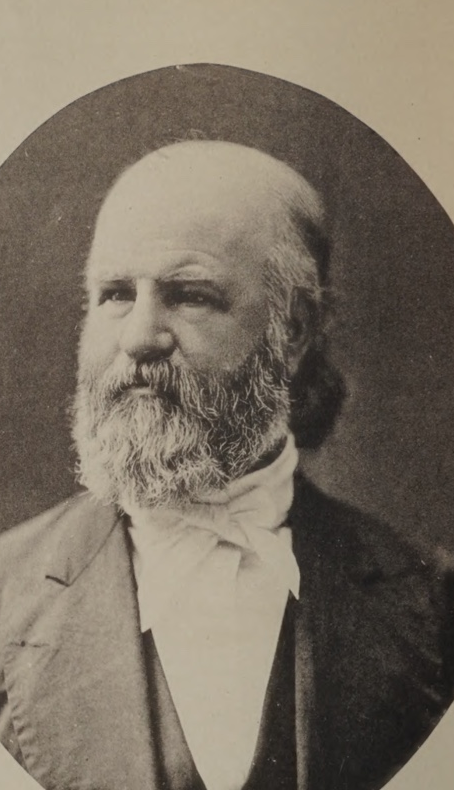
Thomas's reputation was unmistakable.
“He was a violent abolitionist.”
History of Butler County, Ohio, Presbyterian Church history, p. 303.
The nineteenth-century wording is preserved exactly as printed. In context, “violent” describes the force or intensity of Thomas's abolitionism, not documented physical violence.
Portrait and Correspondence Volume
The project is now using a portrait of Thomas reproduced from a bound Butler County Public Library volume titled T. E. Thomas Anti-Slavery Correspondence. The same volume visually reinforces how substantial Thomas's documentary antislavery record was and gives the project a better grounded portrait source than a generic website reproduction.
Why He Matters
Thomas Ebenezer Thomas served First Presbyterian Church in Hamilton during the 1840s, when slavery was becoming an increasingly public issue within the Presbyterian Church. His record goes well beyond quiet antislavery sympathy. He published against proslavery theology, helped organize Presbyterian antislavery action in Hamilton, preached directly on slavery, and became known beyond Ohio as a prominent abolitionist church leader.
“In great questions of morals and public justice, ministers, it appears to me, are bound to let their voice be heard.”
Thomas E. Thomas, Hamilton, July 11, 1840
Miami University and the Antislavery Network
Thomas graduated from Miami University in 1834, the same year as Joseph Glass Monfort. Historian James H. Rodabaugh places Thomas among the former Miami students who continued President Robert Hamilton Bishop's reform work within the Presbyterian Church. Rodabaugh describes Thomas as one of the leading figures who carried the struggle against slavery forward after Bishop's presidency.
This Miami connection matters to Hamilton because Thomas did not arrive in the city as an isolated antislavery voice. He came out of a regional Presbyterian environment in which slavery, church policy, reform, and abolition were already being debated intensely. The Miami University Anti-Slavery Society had been formed in 1834, and student antislavery activity included public speaking, distribution of pamphlets, and support for antislavery newspapers.
Source: James H. Rodabaugh, “Miami University, Calvinism, and the Anti-Slavery Movement,” Ohio Archaeological and Historical Quarterly. Read source →
“I hope to preach an anti-slavery sermon yet, in your church ... unless he fears to meet the truth.”
Thomas E. Thomas to Prof. John W. Scott, Rossville, February 7, 1842
First-person quotations: Correspondence of Thomas Ebenezer Thomas: Mainly Relating to the Anti-Slavery Conflict in Ohio, Especially in the Presbyterian Church (1909), published by his son Alfred A. Thomas.
The 1844 Hamilton Anti-Slavery Convention
In August 1844, Thomas asked Dr. Gamaliel Bailey to publish a call for a Presbyterian Anti-Slavery Convention in Hamilton. At the September meeting, Thomas served on committees charged with preparing a memorial to Synod, addressing churches, preparing an antislavery tract, and supporting an antislavery newspaper. The record places him near the center of organized Presbyterian resistance to slavery in Hamilton.
Antislavery Preaching and Writing
Thomas published A Review of Rev. Dr. Junkin's Synodical Speech in Defence of American Slavery in 1844. In July 1847 he preached two Hamilton discourses later published as Covenant Breaking, and Its Consequences, arguing that slavery was a moral and political question that could not simply be excluded from a faithful pulpit.
Two Hamilton sermons published in Rossville, 1847
Thomas delivered sermons on July 4 and July 11, 1847, subsequently published in Rossville by J. M. Christy as Covenant Breaking, and Its Consequences; or, The Present Posture of Our National Affairs, in Connection with the Mexican War. The Library of Congress preserves a digitized copy of this contemporary publication.
The dates place the sermons within Thomas's Hamilton pastorate and the year of the Presbyterian congregational reunification. The publication is direct evidence of his preaching and local print activity; the exact delivery venue and specific statements about slavery require examination of the complete text. It does not establish that Thomas personally conducted Underground Railroad operations.