John Woods in 1854
Signature and October 20, 1854 railroad letter, plus the 1853 church-trustee evidence.
View source page → CONTACT
This page highlights a manageable selection of primary sources, historic publications, photographs, and public archives used in the project. It is intentionally not a complete copy of the project's internal research files, indexes, working briefs, or active research leads.
Read PDF opens a historical document hosted with the project. View at archive opens the original public archive or publisher page. This public-facing page presents selected evidence only. Working indexes, internal research briefs, and active lead files remain part of the project archive rather than the public website.
These are the principal BCHS items added in this review build. They strengthen person, church, site, and source documentation while preserving the distinction between direct Underground Railroad evidence and later historical context.
Signature and October 20, 1854 railroad letter, plus the 1853 church-trustee evidence.
View source page →1962 history, historic photographs, 1934 fire account, Rankin Risk clipping, and 1916 Martha Beckett reminiscence.
Review the place page →Marjorie Graeff history and the November 11, 1946 handwritten church history.
Review the place page →The July 27 Hamilton Intelligencer page contains two separate articles about the same freedom seeker episode. The Research Library treats them as two articles from one issue and one newspaper page, not as two separate July 27 records.
View both articles →New project photograph and a dedicated place page for the surviving house built for Noah C. McFarland.
View place page →Expanded Rossville origin and 1964 relocation context, with a clear non-UGRR evidence boundary.
View context page →Each trail starts with a question from the Hamilton story and takes you directly to the records used to investigate it.
Start with the contemporary newspaper, then compare it with McMaken's later testimony and the project's evidence synthesis.
1. Read the principal July 27 “Fugitive Slave Case” source → 2. Read the companion article on the same newspaper page → 3. Find the McMaken testimony → 4. See how the evidence fits together →Move from First Presbyterian's own history to David McDill's writings and the Thomas E. Thomas papers.
1. Read the 1876 church history → 2. Read Life of David McDill → 3. Explore the Thomas correspondence →Start with modern archival scholarship, then go back to Cone's nineteenth-century account and the 1854 operational evidence.
1. Read Brad Spurlock's Anderson article → 2. Search Cone's Hamilton history → 3. Review Anderson's project profile →Trace the evidence connecting Hamilton with Cincinnati, the Great Miami crossing, West Elkton, Darrtown, Fairhaven, and the Quaker network.
1. Start with the Siebert route sources → 2. Explore the route reconstruction → 3. Walk the Hamilton portion →See how one FamilySearch discovery opened a larger source trail connecting an 1892 Hamilton newspaper biography, Cone's 1896 account, federal military records, and modern scholarship by Robert S. Wicks and Fred R. Foister.
1. Examine the 1892 Republican article → 2. Review Elliott's evolving profile → 3. Compare the newspaper evidence →Contemporary statement by Elliott, first published in the Hamilton Telegraph and reprinted in the Hamilton Intelligencer. Elliott denied enticement allegations and explained Officer Bruen's presence on the train.
View source page →Contemporary article reproducing the charges brought by Mark Campbell McMaken against Marshal John C. Elliott and the city proceedings that dismissed them.
View source page →These are among the most important sources for establishing Hamilton's Underground Railroad activity, the 1854 case, and the people who appear in the local network.
Wilbur H. Siebert's Hamilton interview with McMaken is the project's central operational account. It identifies John Woods, David McDill, McFarland, Judge Wilkins, the sheriff (Peter Murphy held the office in 1854; McMaken later misremembered him as Bill Allen), Alfred Anderson, John Ward, "Dr. Rigden," the railroad bridge, warning correspondence, and onward routing.
View direct scan →Contemporary report of the arrest and habeas corpus proceeding. It names N. C. McFarland, John R. Lewis, Judge Wilkins, and the release of the freedom seeker, who the paper reported left with several conductors on the Underground Railroad.
Open source page → View newspaper page at Ohio Memory → View full July 27 issue → External archiveA second article on the same newspaper page adds “Jenny Acres,” Officer Bruen, Cincinnati depot/rail movement, a dray, jail and courthouse details, and discussion of possible false imprisonment.
Open source page → View newspaper page at Ohio Memory → View full July 27 issue → External archiveElliott's published account, first appearing in the Hamilton Telegraph and reprinted by the Hamilton Intelligencer, describes “Mr. Carpenter, the person to whom the negro was hired,” and separately mentions a nephew of the enslaver. Elliott also defended Officer Bruen against the enticement allegation.
Open Elliott source page →A separate August 3 follow-up preserves claimant-side testimony concerning the escape and the Kentucky-to-Ohio movement. The project keeps this article separate from Elliott's statement because the accounts contain distinct details that should not be silently merged.
Browse Hamilton Intelligencer → Standalone source link to finalizeSiebert identifies “Rev. Rusk” as an Associate Reformed preacher and conductor whose property was in what later became Spring Grove Cemetery. The note says he took freedom seekers to the Stubbs family at West Elkton and “would go through Hamilton here in the night.” His exact identity remains unresolved.
Open source page → Read preserved PDF →An 1847 Hamilton County deed conveys approximately 130 acres in Section 19, Township 3 of the Miami Purchase to B. B. Rusk for consideration appearing as $1,950. The legal description gives the project a specific antebellum property to map and compare with Siebert's later description of Rev. Rusk's property.
Open source page → Read preserved PDF →Hanover College's online Monfort collection lets readers follow Elias Riggs Monfort through the Civil War in his own words. The letters document military life, enslaved people reaching Union lines, reactions to emancipation, race, religion, and the rapidly changing meaning of freedom during the 1860s.
Explore the letters at Hanover → See why they matter → External archive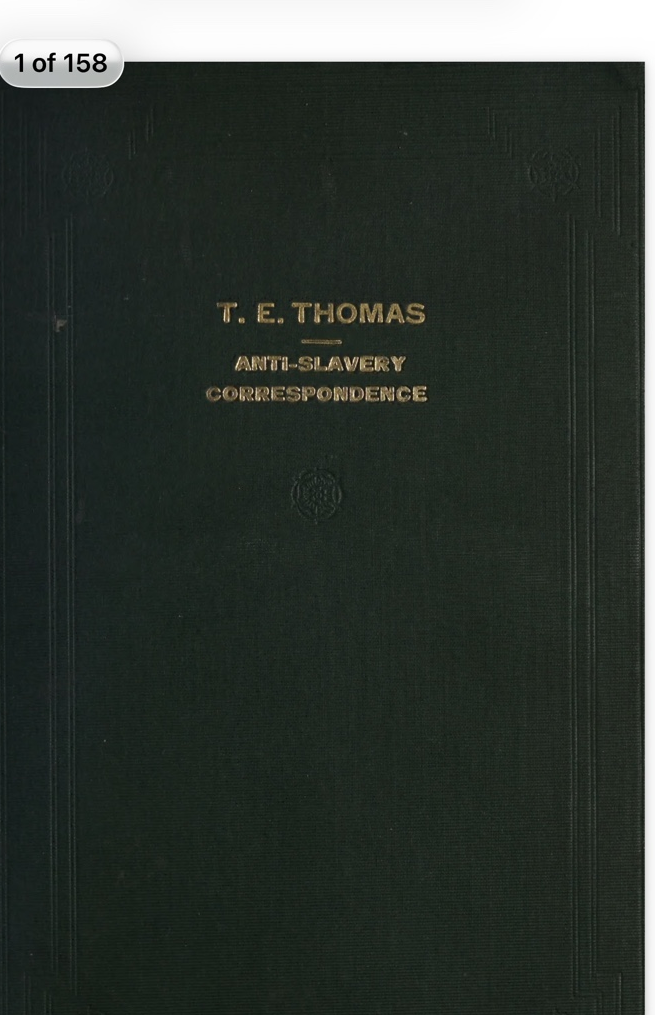
A bound Butler County Public Library volume preserving Thomas-related antislavery correspondence. The volume also contains a portrait of Rev. Thomas Ebenezer Thomas now used on this website. It is an important project source for Thomas's antislavery network and documentary legacy.
Read project PDF → Local source volume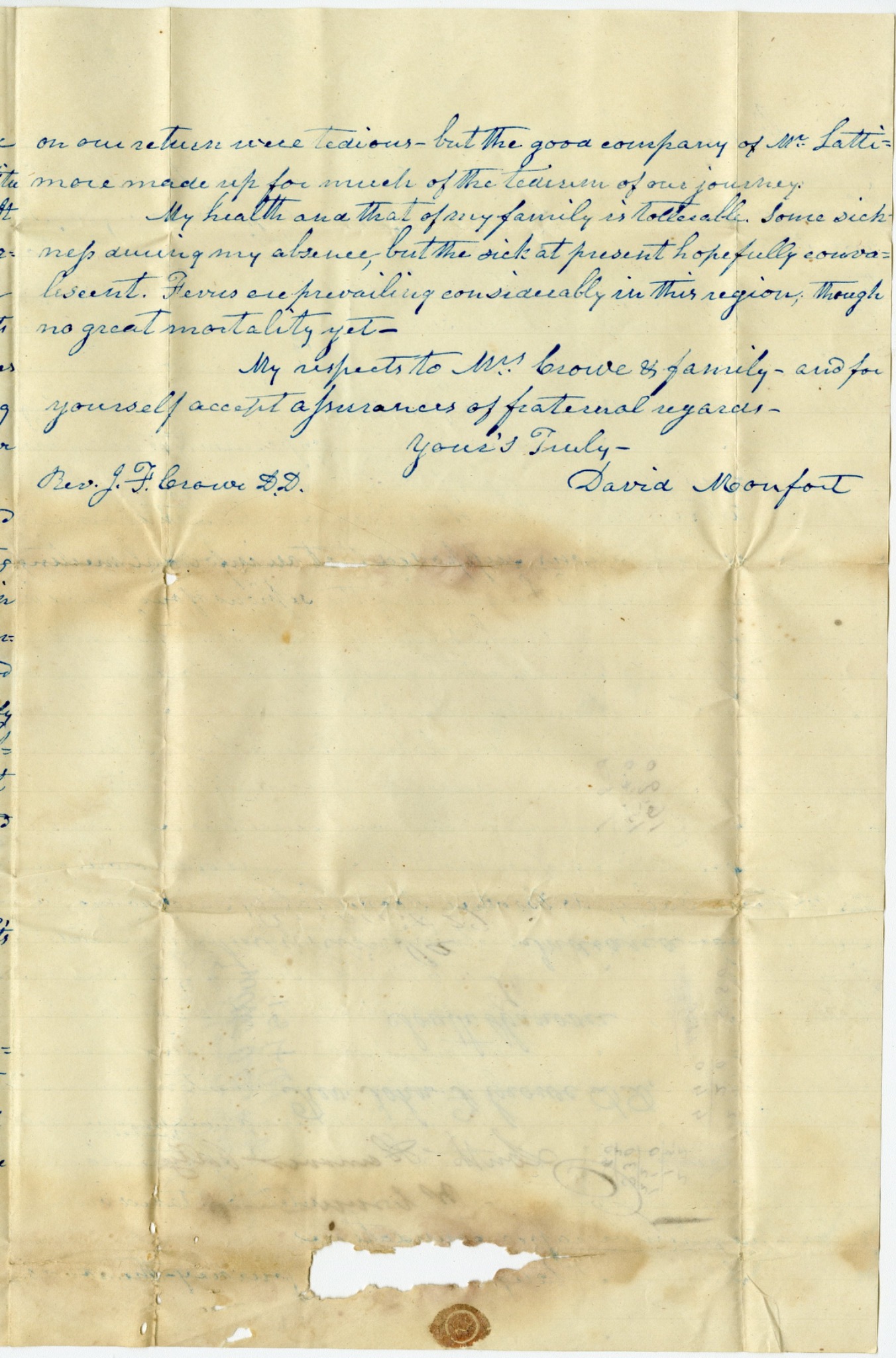
An original manuscript letter in David Monfort's hand documents his correspondence with Rev. John Finley Crowe and his involvement in Presbyterian institutional discussions concerning Hanover College and the Synod. The surviving pages also preserve Monfort's signature.
Explore the source → David Monfort's page → Primary source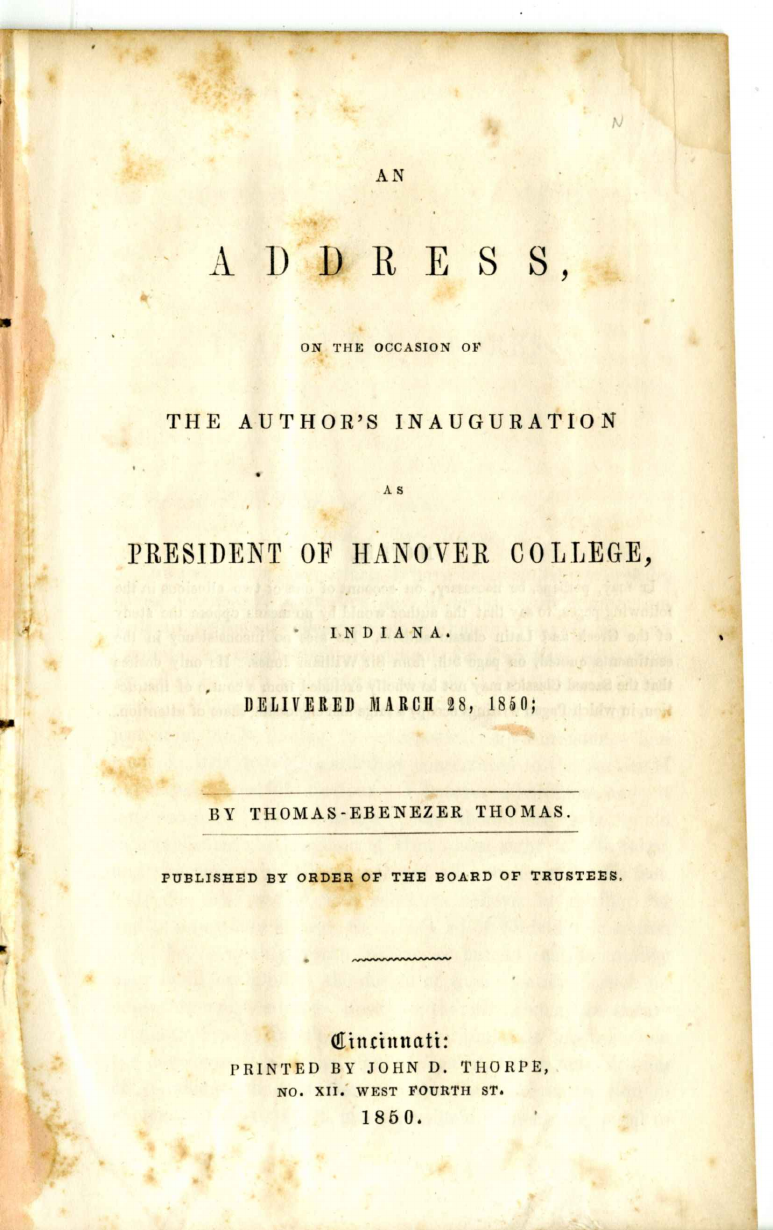
Thomas's inaugural address as president of Hanover College documents his move from Hamilton's Presbyterian ministry into college leadership. The address discusses Christian education, justice, freedom, the rights and brotherhood of man, and the responsibility of colleges to prepare future civic, legal, religious, and political leaders.
Explore the source → Read full PDF → Primary source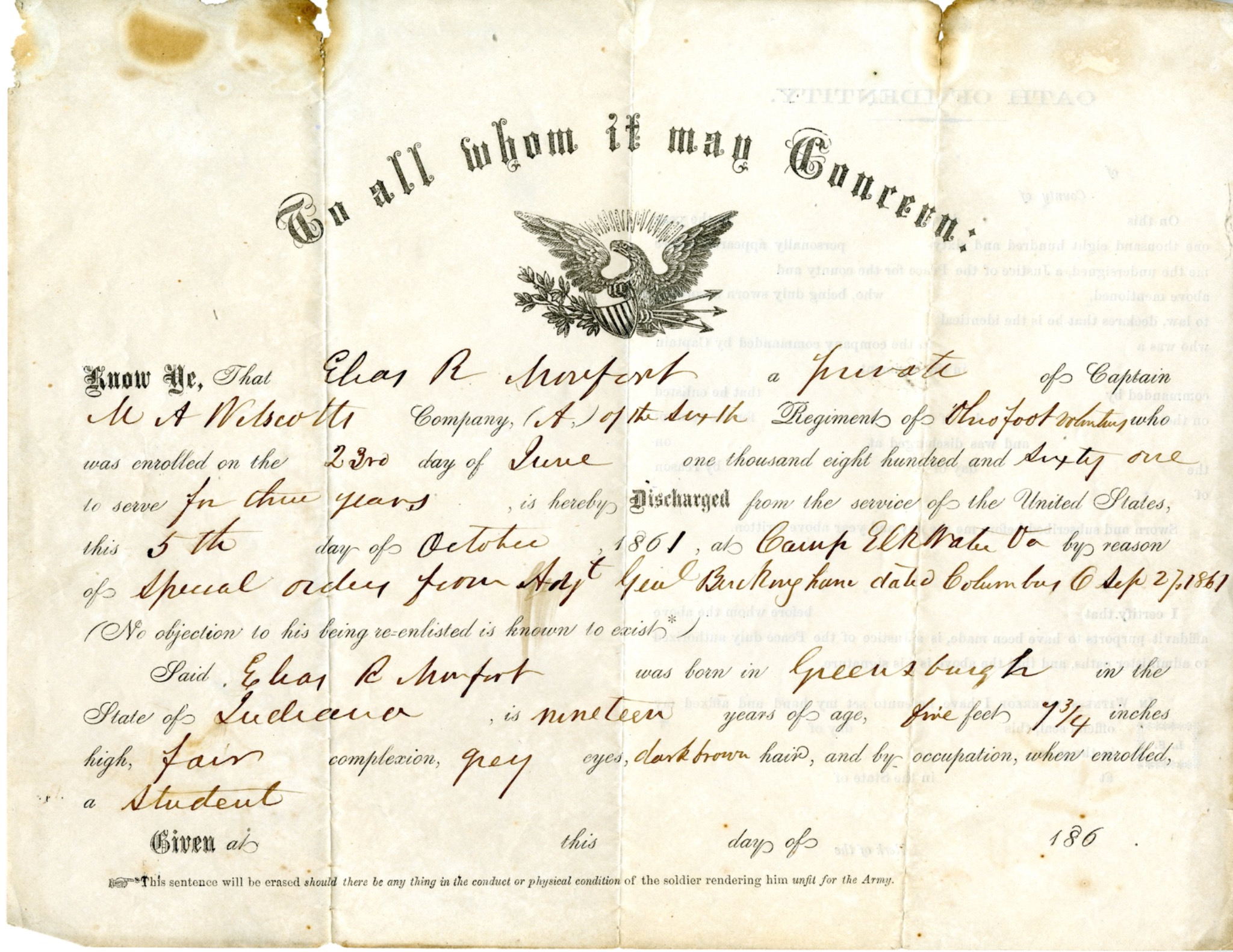
An original discharge identifies nineteen-year-old Elias R. Monfort as a private in Company A of the 75th Ohio Volunteer Infantry and records his birthplace, age, height, complexion, eye color, hair color, and occupation as student.
View source →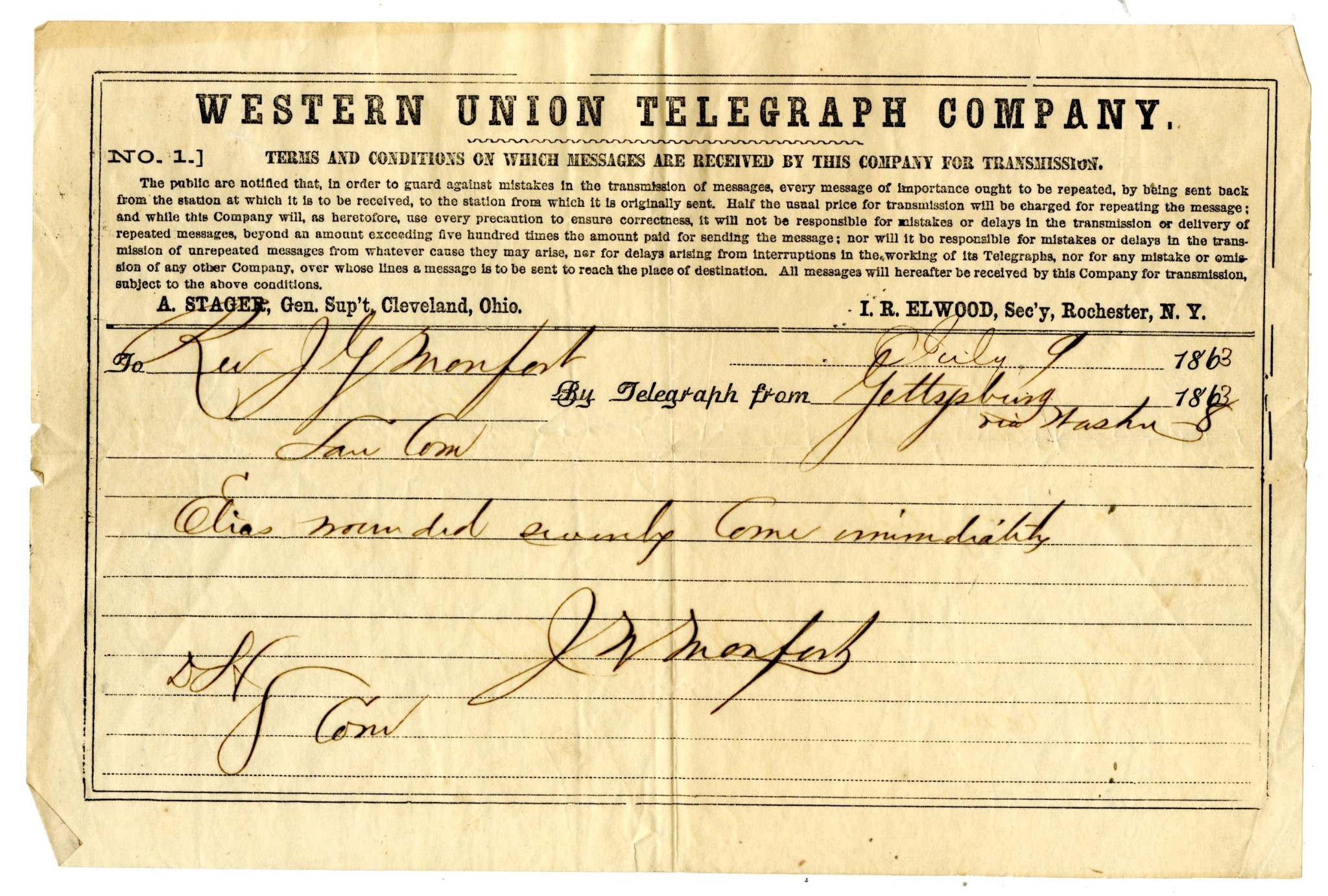
An urgent Western Union telegram reported that Elias Riggs Monfort had been severely wounded and asked the family to come immediately. The document adds a personal Gettysburg chapter to the Monfort family correspondence.
View source →Correspondence associated with Rev. Thomas E. Thomas, including material relevant to Presbyterian antislavery organizing, the 1844 Hamilton convention, and the broader church network.
Read PDF → Project copyDetailed congregational chronology with McDill, Davidson, the January 27, 1853 trustee transaction involving John Woods, later building history, and antislavery institutional memory.
Read PDF →Preserves the congregation's later historical narrative, including the 1834-1835 period in which the church is described as passing strong resolutions against slavery.
Read PDF →Handwritten local history preserving early building, Wallace, Monfort, settlement, and nineteenth-century church chronology.
View source page →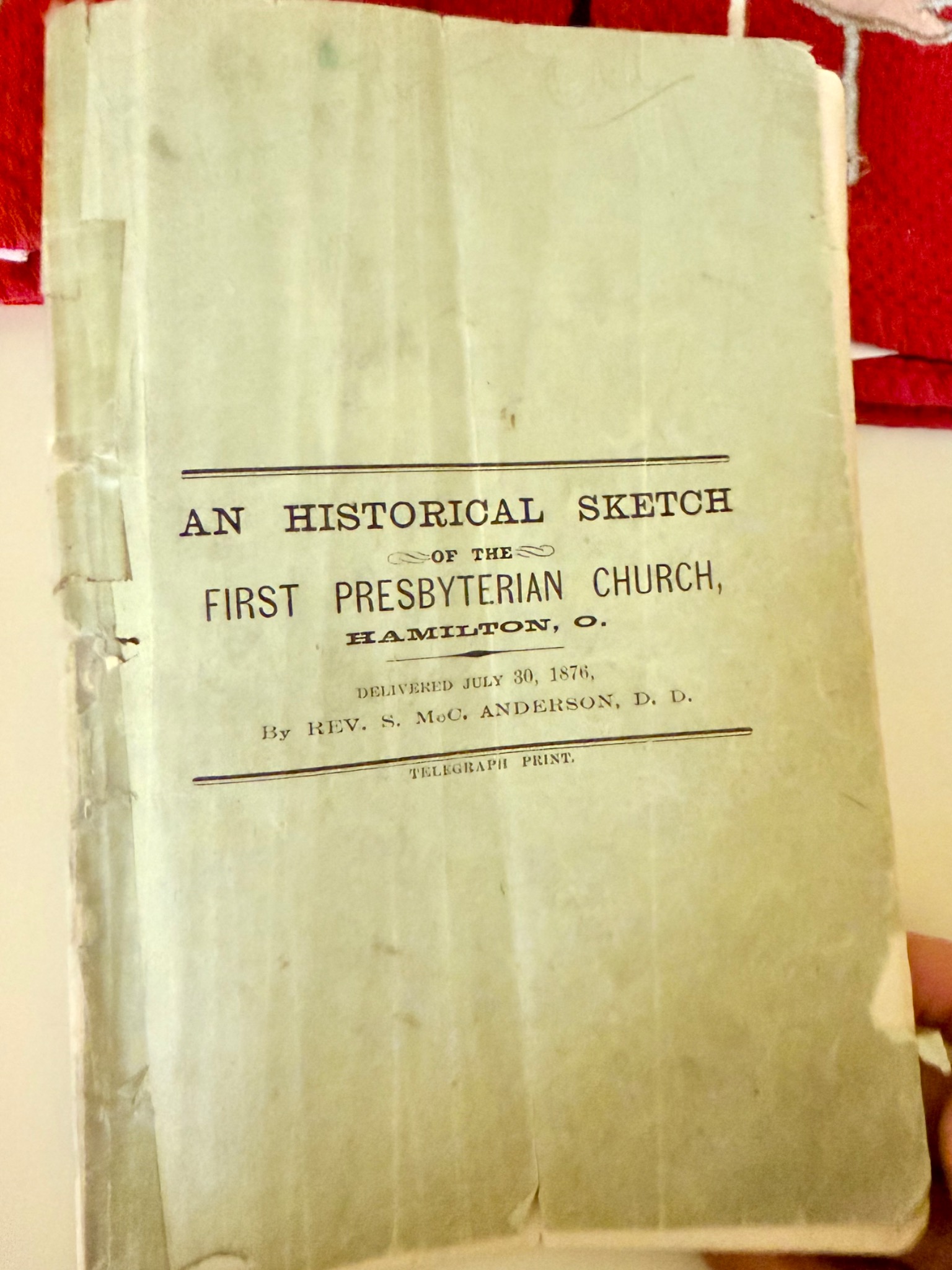
Rev. S. McC. Anderson's 1876 history preserves the congregation's early chronology, ministers, membership, Sabbath School history, antislavery resolutions, and building history.
Read PDF → Public domain historical workEdited by Rev. Marion Morrison. A major source for McDill's Hamilton ministry, antislavery theology, denominational activity, editorial work, and reproduced selections from McDill's own writings.
Read project copy → Open public source → Public domain historical workChapter IV of Marion Morrison's Life of the Rev. David McDill, D.D., pp. 57-74. Morrison identifies McDill as a leader on the antislavery side of the Associate Reformed Synod, describes his role in church action beginning in the 1820s, connects the 1828 slavery debate to the creation of the Christian Intelligencer, and preserves the 1832 “Letter IV. On Slavery.”
Read the full biography →See McDill's profile →A direct Hamilton-connected antislavery publication by Rev. Thomas E. Thomas. The project treats this as an important primary printed source for the theology and arguments circulating in Hamilton's Presbyterian network.
Digital reading copy to addOrange County, Virginia, Will Book 5 establishes William Acre as father of Jane, Polly, Robert and the wider Acre family under investigation. The estate inventory names Ailse, Ben, Rachel, Peter, Winny, and Kitt, creating the strongest documentary bridge yet to the later Boone County Acra ownership chain.
Open source images and research note →A major secondary study of Miami University's Presbyterian identity and its role in the antislavery movement. Rodabaugh documents Robert Hamilton Bishop's reform background, the formation of the Miami University Anti-Slavery Society on June 12, 1834, student antislavery speaking and publication activity, and the later work of Miami graduates Thomas E. Thomas and Joseph Glass Monfort within the southern Ohio Presbyterian antislavery movement.
Read at Ohio History Journal → Ohio History Journal archiveThe Hamilton periodical edited in the Associate Reformed milieu carried sustained antislavery theological material beginning with its first year of publication. Individual issues and articles are being added as direct scans are verified.
Issue-by-issue verification in progressA major nineteenth-century reference for Hamilton institutions, churches, civic figures, the hydraulic system, early settlement, and Butler County communities. It is valuable for corroborating local relationships and geography.
Read project copy → Read at Internet Archive → Public domain historical workA nineteenth-century Hamilton publication useful for civic history, institutional chronology, local biographies, and checking later traditions against a source produced close to the Underground Railroad era.
Read at Internet Archive → External archiveCone's large Hamilton history is a key near-contemporary reference for residents, institutions, churches, civic offices, businesses, transportation, and later recollections of antebellum events.
Read PDF → Public domain historical workButler County Probate Court's history of the public-square courthouses, including the 1810 structure, the 1817 courthouse remodeled in 1837, and the present courthouse completed in 1889.
Read the official history →A nineteenth-century engraving shown by the Butler County Fair history project appears to depict the earlier courthouse with its portico and clock tower. Original publication provenance is still being traced.
View the source page →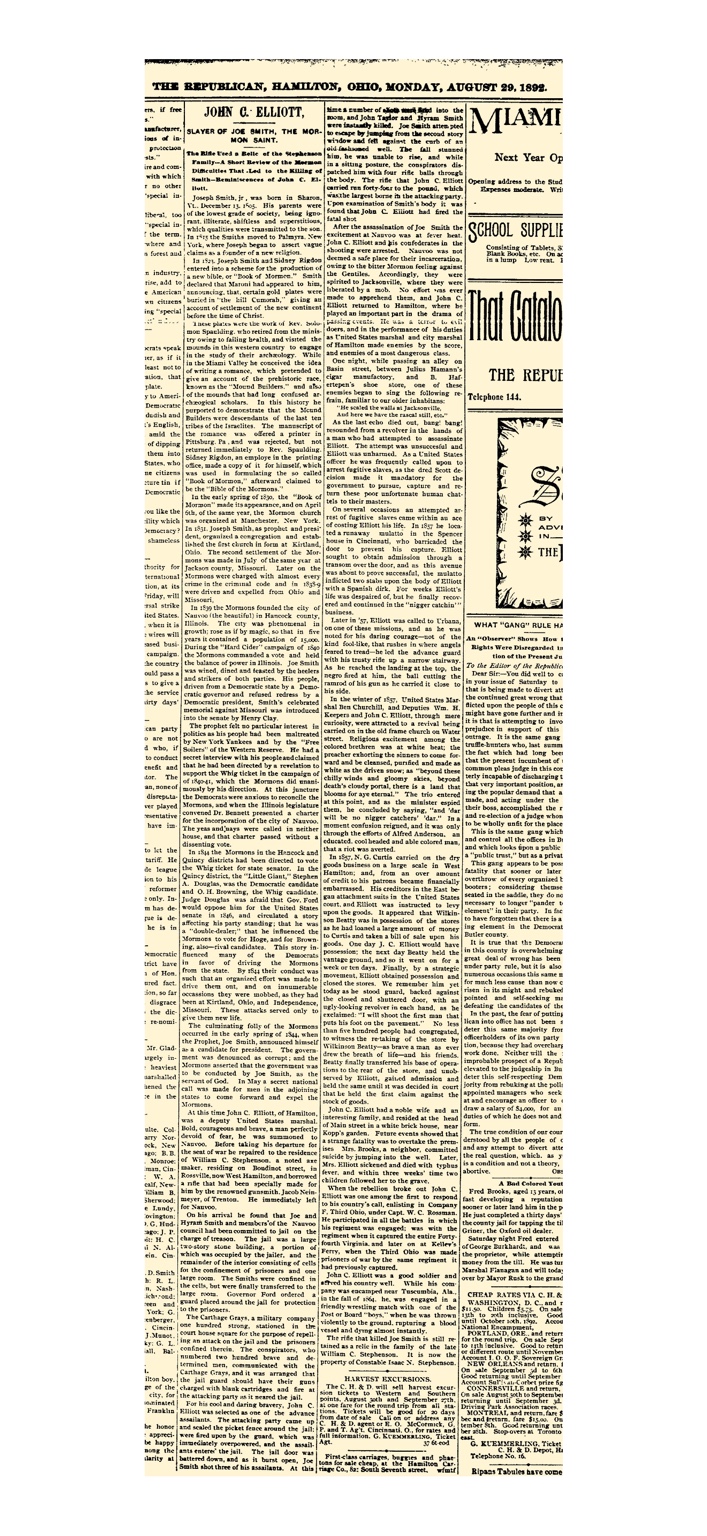
A newly surfaced long-form Hamilton biography that predates Cone's 1896 account. It brings together Elliott's law-enforcement career, Fugitive Slave Act enforcement, the 1857 African Methodist church confrontation, family tragedy, Civil War service, and the local Joseph Smith tradition.
Follow the research → View article image → Project research copyBrad Spurlock's detailed profile of Anderson brings together his abolitionism, voting-rights case, civic activity, Black convention leadership, and the 1857 African Methodist church confrontation.
Read the article → Journal-NewsBrowse digitized issues of Hamilton's nineteenth-century newspaper yourself. This is one of the most important places to continue digging beyond the articles already cited on this website.
Browse the collection → Ohio History ConnectionMany nineteenth-century Hamilton, Butler County, Presbyterian, and denominational books are available in full text here. The library links directly to specific volumes when we have verified them.
Search Internet Archive → External libraryNames and spellings vary across nineteenth-century records. Try alternate forms such as McDill/MacDill, Monfort/Montfort, Rigden/Rigdon, and McKeen/McKean when following a lead into an archive.
Historic photograph of the jail associated with the 1854 freedom seeker case. Photograph by George Cummings. Shared for the project with assistance from Brad Spurlock, Smith Library of Regional History and Cummins Local History Room, Lane Libraries.
View photograph → Explore the jail →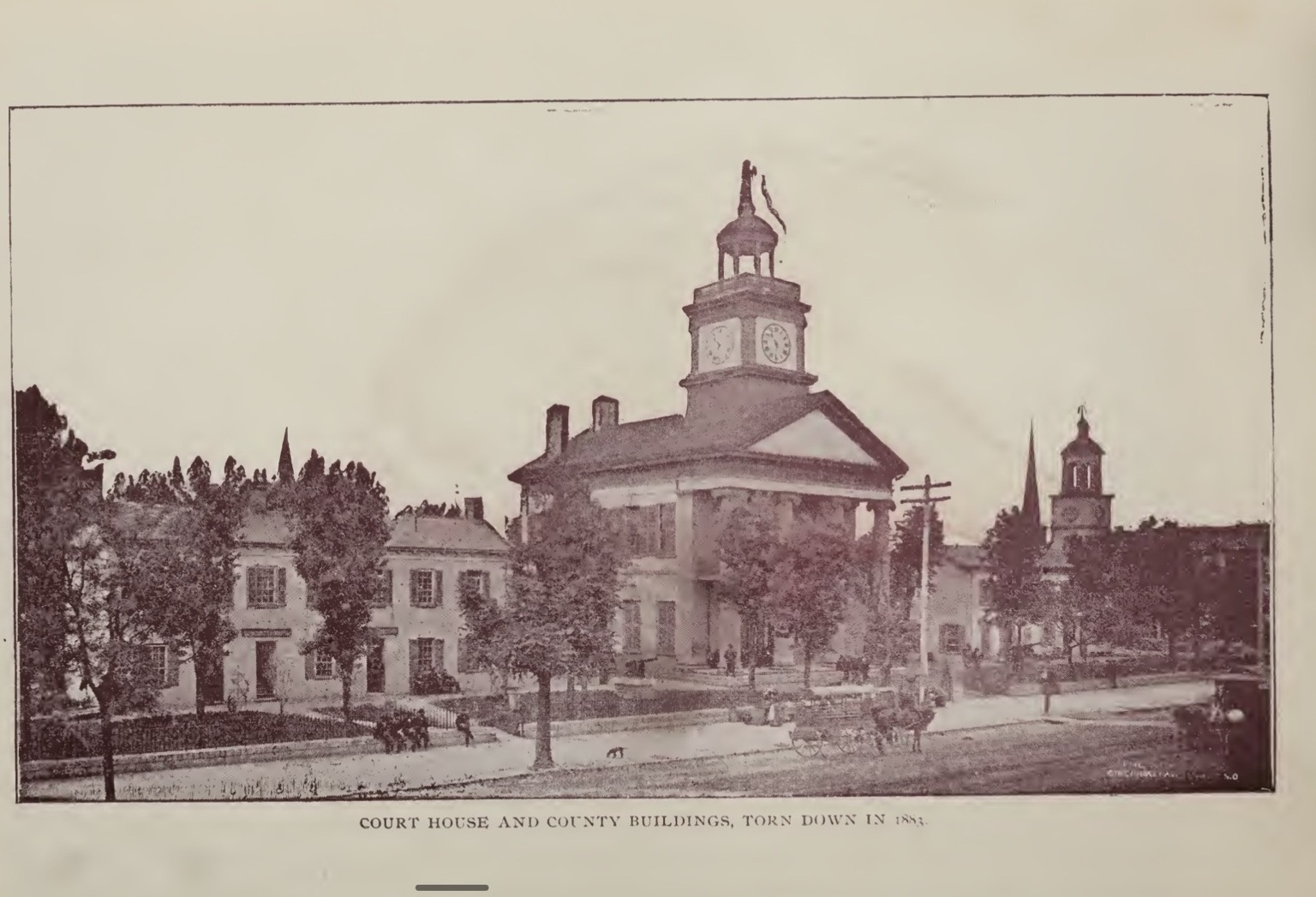
Nineteenth-century published image of the courthouse complex that stood during the July 1854 case. Preserved in D. W. McClung's Hamilton centennial volume.
View image → Explore the courthouse →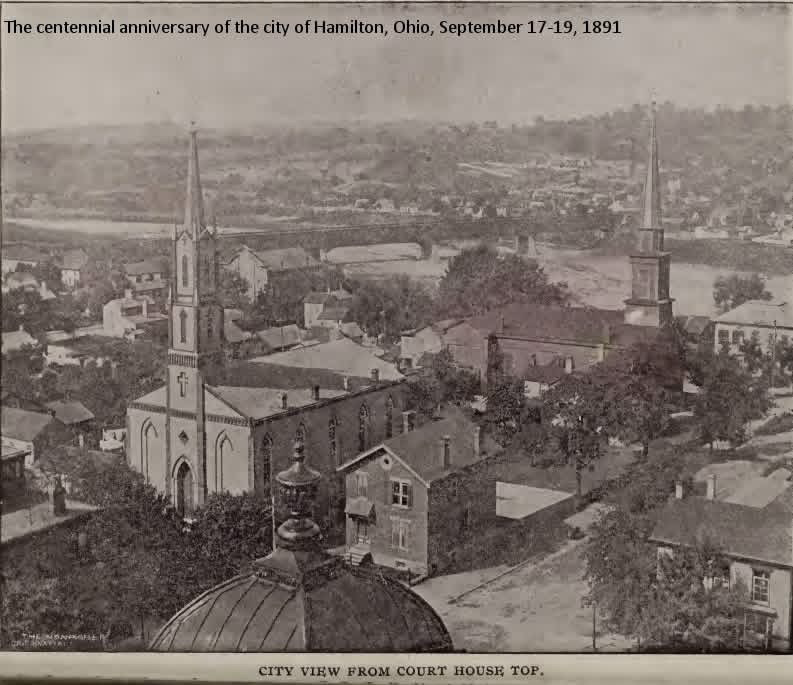
Published view associated with Hamilton's 1891 centennial. The image is valuable for interpreting the compact relationship among the public square, churches, river, neighborhoods, and transportation landscape.
View image →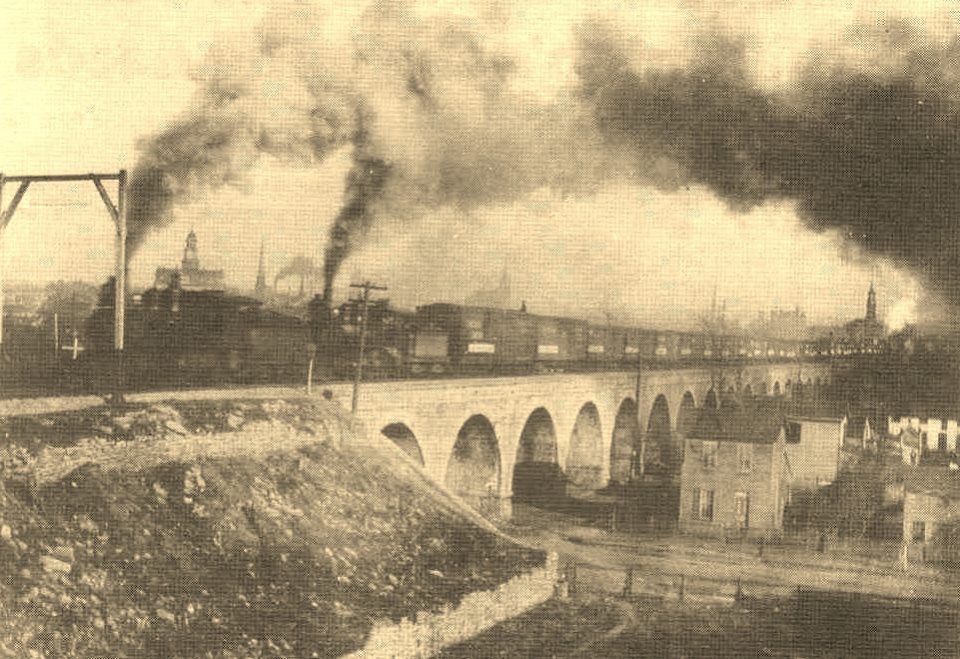
Historic view of trains using Hamilton's masonry railroad approach. It helps visitors identify the surviving infrastructure associated with the Great Miami crossing corridor. The photograph is later than the 1854 case and is used as landscape context, not as an image of the escape itself.
View photograph →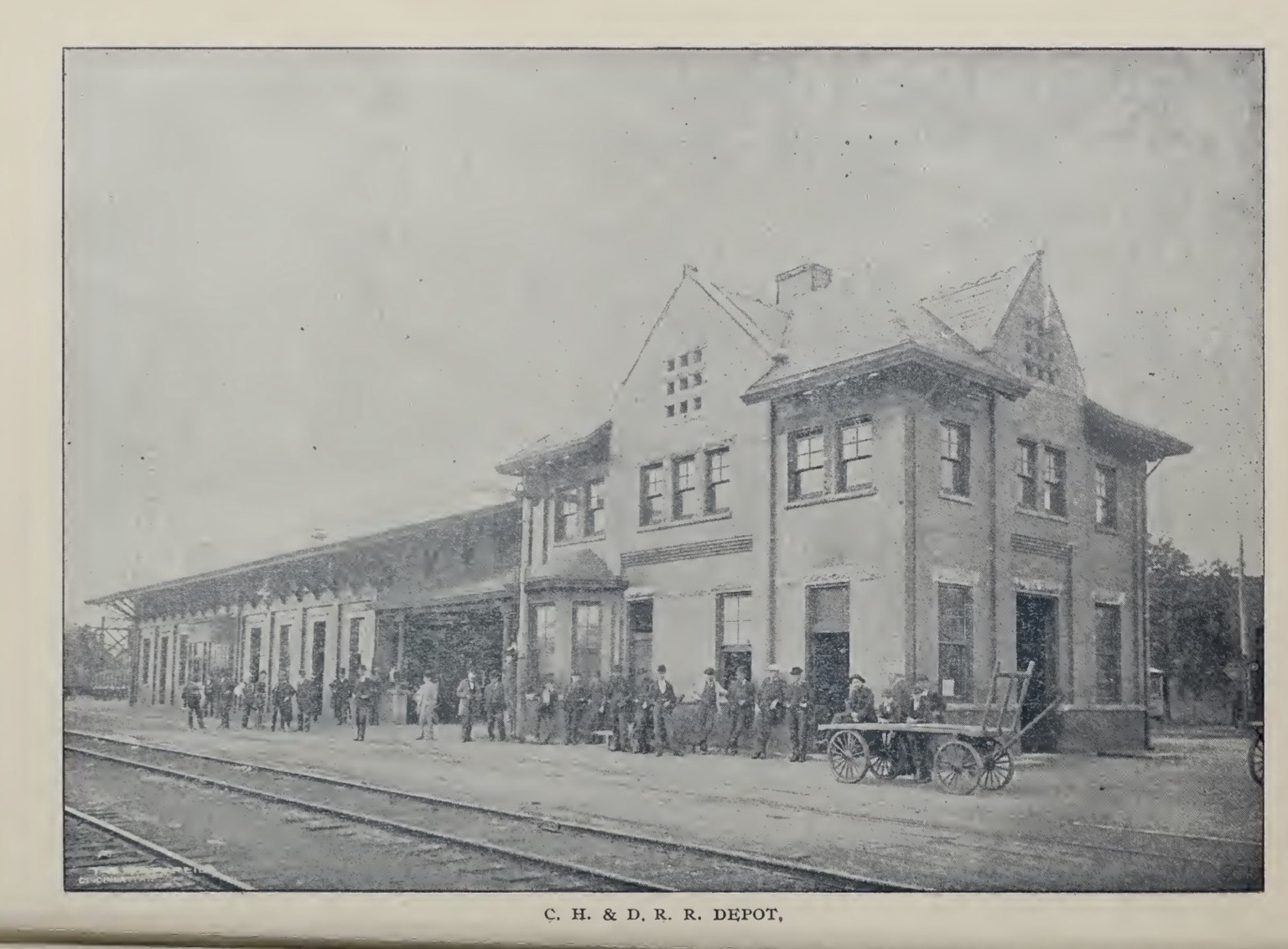
Historic depot view used to interpret Hamilton's railroad environment. The project does not currently claim this specific depot building as the documented 1854 arrival point.
View photograph →The Hamilton project draws on a much larger working research archive. Only selected sources are presented here so visitors can examine the strongest and most useful evidence without turning the website into the project's internal filing system.
Two sermons preached in Hamilton in July 1847 and printed in Rossville. Digitized original at the Library of Congress; sermon text awaits closer examination.
Contemporary acquisition list for evaluating the unresolved B. B. Rusk Section 19 tract. No direct Rusk-to-cemetery sale is identified in the published list.