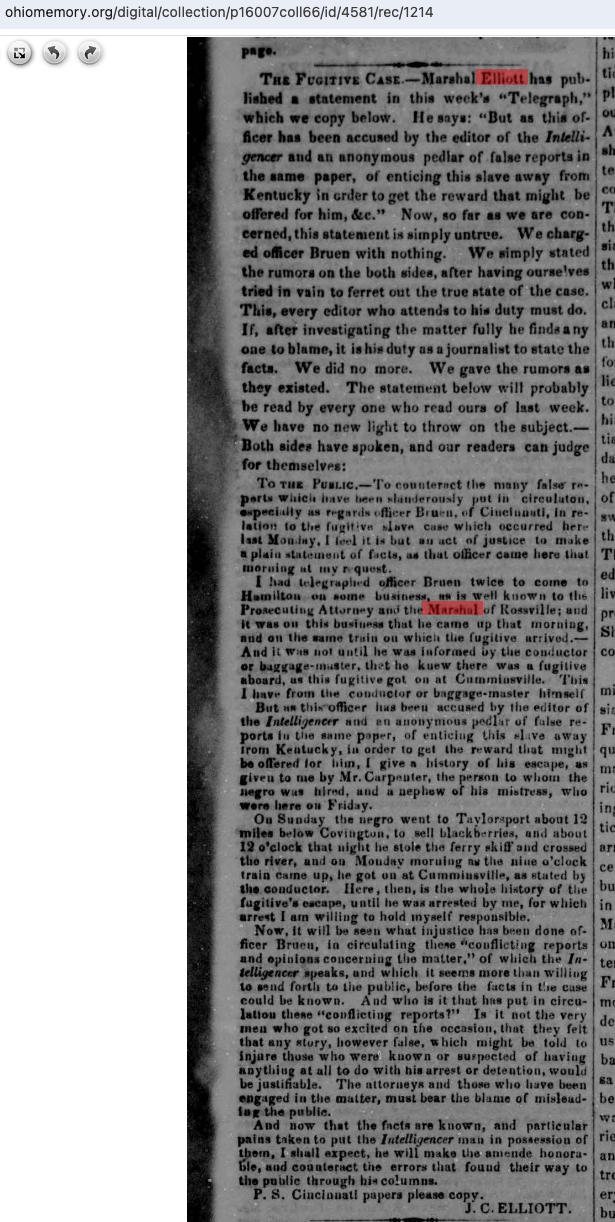
What Elliott said
Elliott denied the accusation that he or Officer Bruen had enticed the freedom seeker away from Kentucky in order to claim a reward. He stated that he had telegraphed Bruen twice to come to Hamilton on unrelated business, that Bruen happened to be on the same train as the freedom seeker, and that Bruen learned of the man's presence from the conductor or baggage master after the man boarded at Cummingsville.
Elliott also supplied a claimant-side account of the man's route, stating that the freedom seeker had gone to Taylorsport, crossed the Ohio River in a ferry skiff, reached Cummingsville, and boarded the train that carried him toward Hamilton.
Evidence note: This is Elliott's own contemporary public statement. It is valuable because it records his version of the events in 1854, but it should be read alongside the other contemporary reporting and later testimony rather than as a neutral account.