First county court
The first Butler County trial court met in a tavern and then in a former Fort Hamilton military building.
 CONTACT
The legal turning point in Hamilton's best-documented Underground Railroad case. The courthouse standing here in 1854 is gone, but the public-square site remains one of the clearest documented locations in the story.
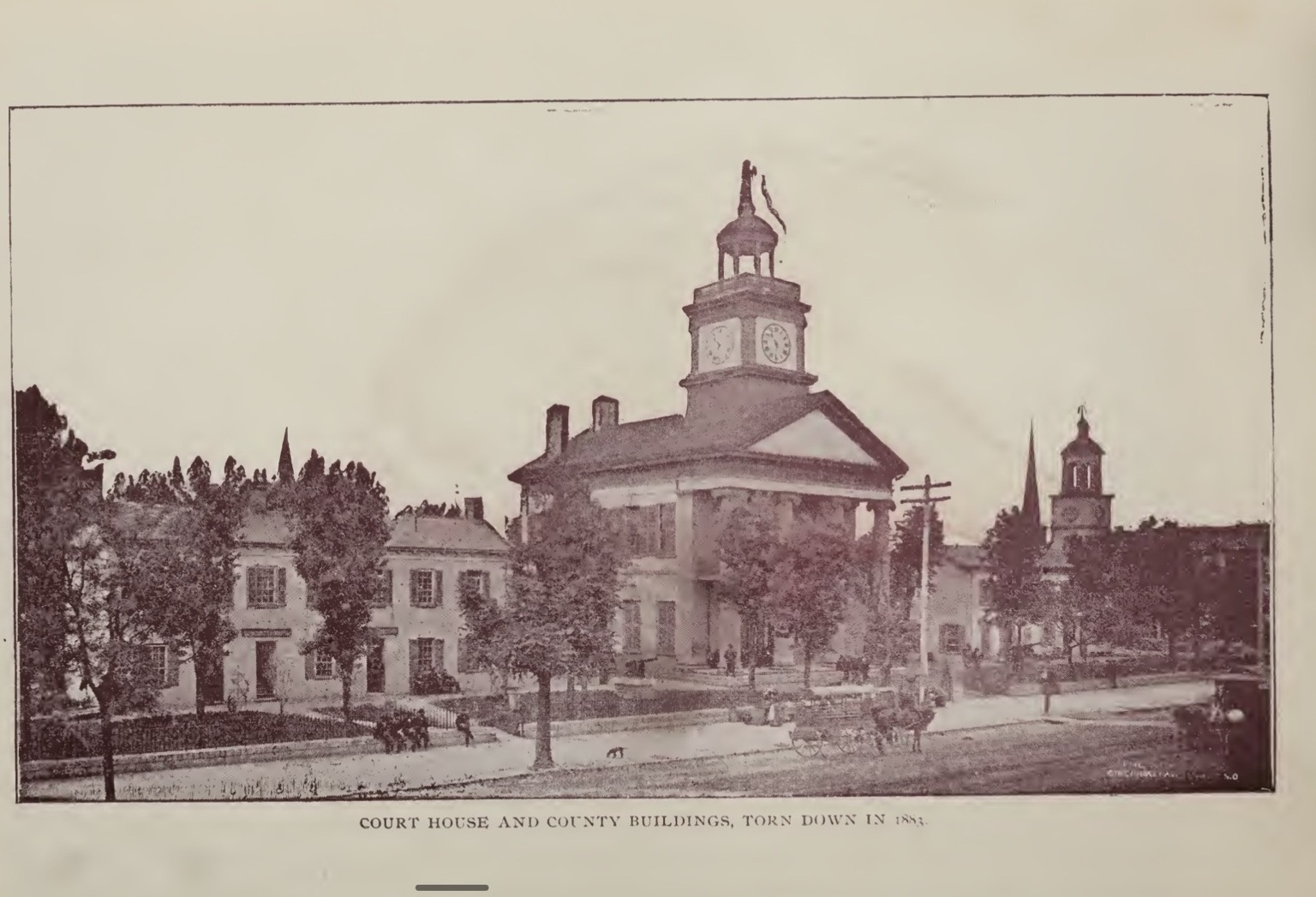

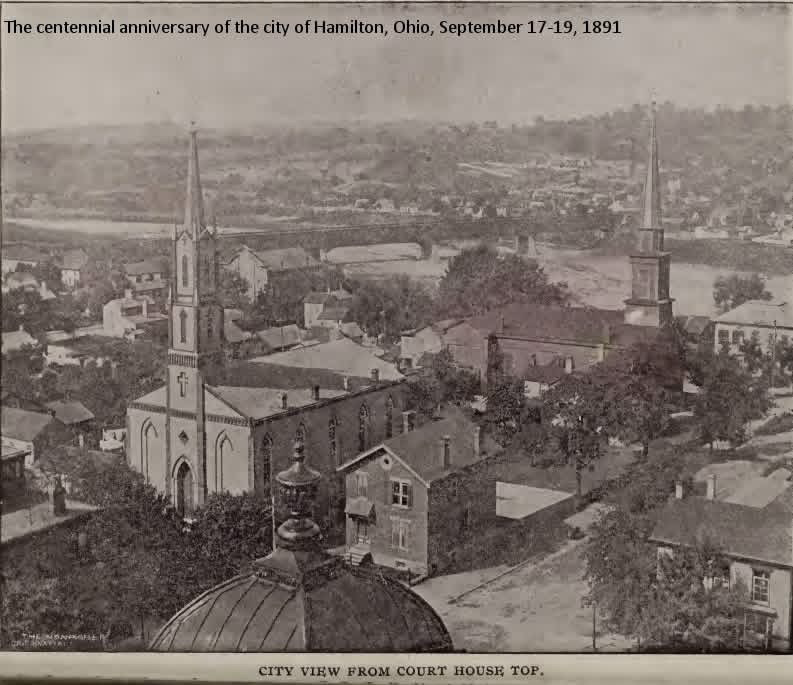
After the detained freedom seeker was taken to the Butler County Jail, attorneys N. C. McFarland and John R. Lewis sought habeas corpus relief. The case came before Judge Thomas H. Wilkins. Contemporary Hamilton reporting records the man's discharge and says that after his release he departed with several Underground Railroad conductors.
This is why the courthouse and jail are treated as separate locations in the project. The jail was the detention site. The courthouse and public square represent the legal challenge that ended that detention.
Butler County's official courthouse history states that a new two-story brick courthouse was erected on the public square in 1817. In 1837 it was extensively remodeled. A portico and Corinthian columns were added, together with a four-sided clock tower and cupola. The building reached approximately 110 feet in height, and its bell was used to signal the opening of court, public occasions, and emergencies.
That remodeled 1817 courthouse was the structure standing on the square during the July 1854 freedom seeker case. It remained in service until 1885, when it was demolished to make way for the courthouse that stands today.
The first Butler County trial court met in a tavern and then in a former Fort Hamilton military building.
A two-story stone building combined a jail on the first floor with a courtroom above.
A two-story brick courthouse was erected on the public square on land donated by Hamilton founder Israel Ludlow.
The courthouse received its prominent portico, Corinthian columns, four-sided clock tower, and cupola.
This was the courthouse standing when McFarland and Lewis challenged the freedom seeker's detention before Judge Wilkins.
The 1817 courthouse was torn down and construction began on its replacement.
The current four-story courthouse was completed and occupied on February 4, 1889.
A tower fire killed three Hamilton firefighters and destroyed the tower, cupola, and Goddess of Justice statue.
The courthouse served as a temporary morgue during the catastrophic flood that killed more than 200 people in the area.
The official Butler County Probate Court history documents the courthouse sequence and confirms that the 1817 building remained in use until 1885. D. W. McClung's 1892 Hamilton centennial volume preserves a published image of the courthouse and county buildings that were torn down in 1885. The July 27, 1854 Hamilton Intelligencer provides the contemporary report of the fugitive-slave case and the habeas corpus proceeding.
Official courthouse history → Read the 1892 Hamilton centennial volume → Read the July 27, 1854 newspaper page → Research Library →The project now has a sourced nineteenth-century published image of the courthouse and county buildings that were demolished in 1885. The image appears in D. W. McClung's 1892 Hamilton centennial volume and is used here as the principal visual reference for the courthouse complex associated with the 1854 case.