
CHURCH
Different buildings. The same congregation.
For this project, Payne Chapel is not treated as a later church that replaced an unrelated antebellum congregation. Historical records trace the same Hamilton A.M.E. community across changing houses of worship. The congregation first organized in a private home, built an early sanctuary in the 1840s, completed a larger Payne Chapel in 1877, and later relocated to South Front Street after the City of Hamilton acquired and demolished the older church property.
One congregation across changing buildings
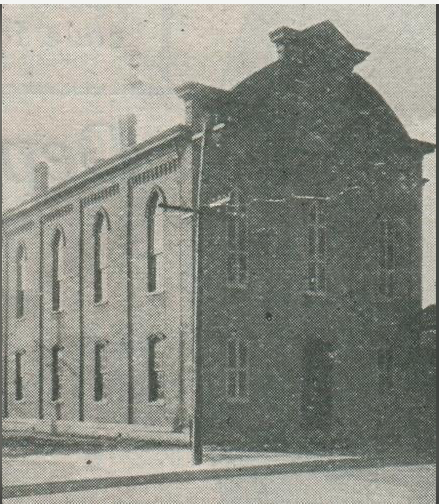
Payne Chapel A.M.E. Church at Pershing Avenue and South Monument Avenue. Photo from Greater Hamilton, Republican News, 1909.
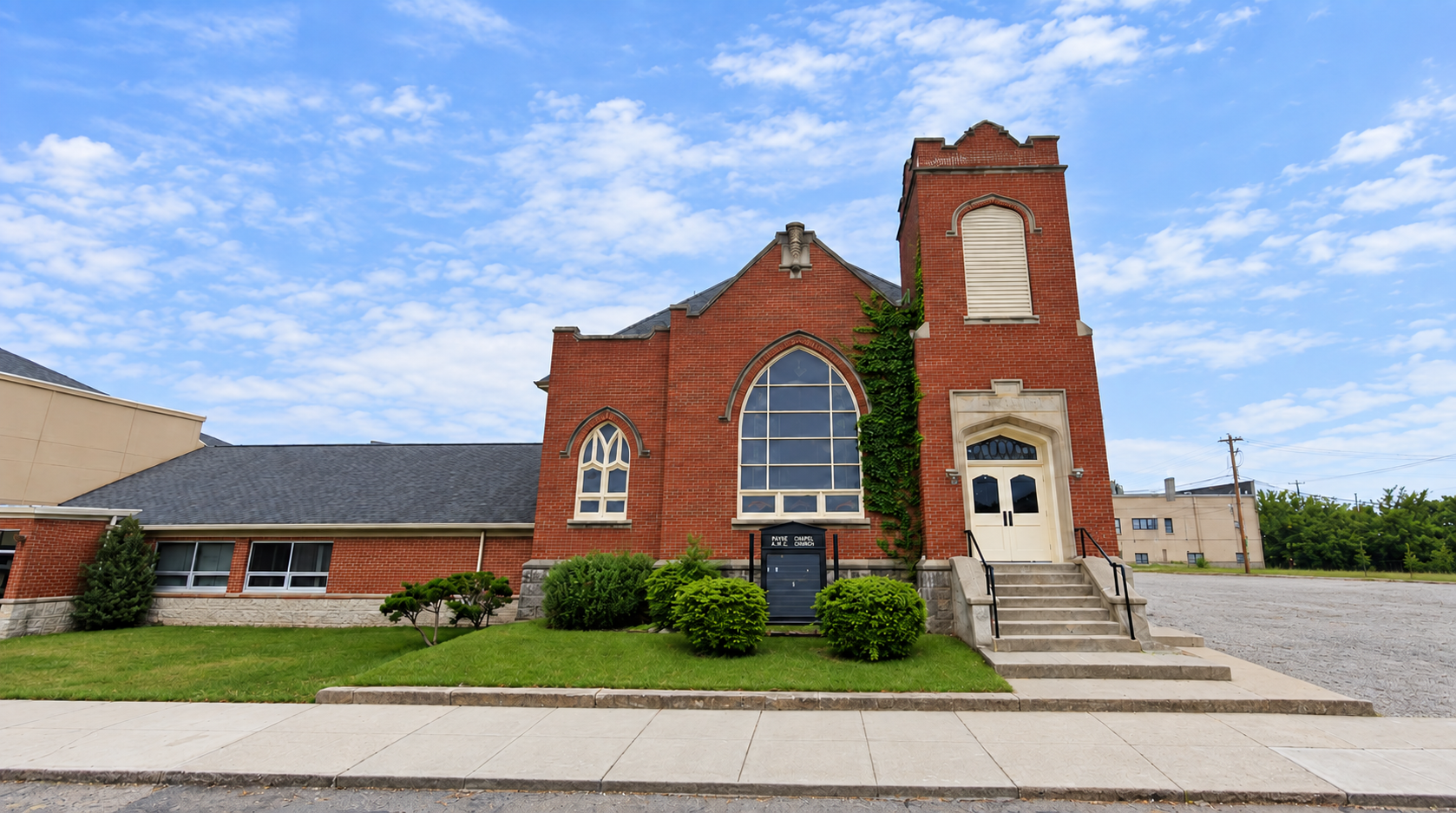
The congregation's current South Front Street home. Current photograph, 2026.
These are different buildings in the history of the same Hamilton A.M.E. congregation.
Black Hamiltonians establish an independent congregation
Late nineteenth-century histories describe Black Methodist families worshiping with Hamilton's white Methodist congregation before organizing their own church. One account explains that racial prejudice restricted Black worshipers to seats near the door or in the gallery. They subsequently organized an independent African Methodist Episcopal congregation, creating a religious and community institution under Black leadership.
The 1891 Hamilton Centennial history dates the organization to 1840 in the home of Matilda Taylor, under the leadership of Rev. Thomas Lawrence of Cincinnati, with nineteen members. It identifies the names Anderson, Sampson, Jones, and Yancy among the early families. The congregation soon secured a lot and erected its first church building, dedicated in 1842.
From the first sanctuary to Payne Chapel
The first house of worship was small, but the congregation grew. Construction of a larger chapel began in 1868 under Rev. A. H. A. Jackson and was completed in 1877 under Rev. Philip Tolliver Jr. The 1882 county history describes a brick church seating about 300 people.
A memorial inside that 1877 building named Alfred J. Anderson and Ira A. Collins on the building committee, along with trustees and church workers who helped complete the new sanctuary. By the late nineteenth century, city directories explicitly identified the congregation as the African Methodist Episcopal (Payne) Church.
A confrontation inside the A.M.E. church
A later Hamilton account records federal officers entering an African Methodist service in 1857 during the era of federal Fugitive Slave Act enforcement. The incident created a dangerous confrontation within a sacred community space. Alfred J. Anderson was later credited with helping prevent the situation from becoming violent.
This episode matters to Hamilton's Underground Railroad history, but it does not define Payne Chapel. The church's importance is broader: it was an institution created and sustained by Hamilton's Black community for worship, mutual support, civic life, education, leadership, and collective action.
From the riverfront to South Front Street
The congregation remained at its nineteenth-century location well beyond the Underground Railroad era. Local historical research reports that the City of Hamilton purchased the old church property and demolished the building in 1953, with the site becoming municipal parking.
Payne Chapel did not end with the loss of that building. In 1956, the congregation purchased the former Grace Methodist Church on South Front Street. The present Payne Chapel complex grew from that move, and a new sanctuary was constructed adjacent to the earlier structure in 1997.
The building changed. The congregation continued.