
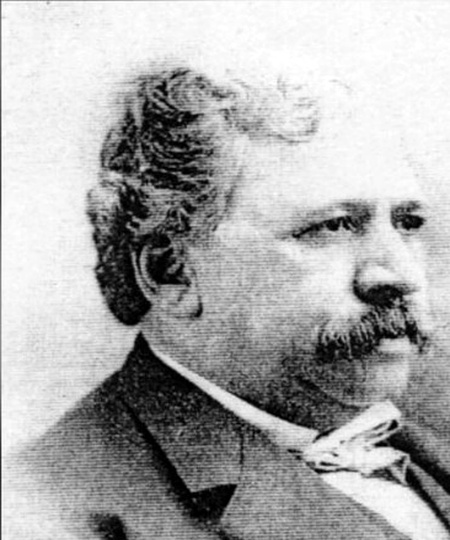
Alfred J. “Alf” Anderson
Few people connect as many parts of Hamilton's antislavery story as Alfred J. Anderson. A barber, writer, Black convention leader, voting-rights litigant, church leader, correspondent and lifelong friend of Frederick Douglass, and direct participant in Underground Railroad operations, Anderson worked for freedom in the street, the church, the press, the courtroom, and the political arena.
Why Anderson Matters
Alfred J. Anderson was one of the most wide-ranging antislavery activists yet documented in antebellum Hamilton. His record reaches well beyond a single Underground Railroad episode. He helped freedom seekers directly, organized Black political action, challenged discriminatory voting laws in court, wrote for nationally important antislavery newspapers, corresponded with Frederick Douglass, and exercised respected leadership within Hamilton's Black church and civic community.
That combination makes Anderson especially important to this project. He shows that Hamilton's antislavery history was not simply a story of white lawyers, ministers, and political allies helping from the outside. Black Hamiltonians were organizing, writing, litigating, protecting one another, and operating within the Underground Railroad network themselves.
From Wheeling to Hamilton
Anderson was born February 24, 1824, in Wheeling, Virginia, before the creation of West Virginia. His mother, Mary T. Clark, was a free woman of mixed race. Local historical research identifies his biological father as James Shannon, a white lawyer from the prominent Shannon family. After Mary married Robert G. H. Anderson, Alfred adopted the Anderson surname.
The family left Wheeling for Cincinnati while Alfred was still young. During the 1832 cholera epidemic they moved through Hamilton and Richmond, Indiana, before settling permanently in Hamilton by 1837.
Anderson received only a few months of formal schooling, but he educated himself through extensive reading and study and learned French and Spanish. Nineteenth-century local history remembered him as a man of strong intellect, presence, and character.
A Voice in the Antislavery Press
Anderson entered antislavery public life while still a teenager. In 1843 he was associated with the Palladium of Liberty, the first Black newspaper published in Ohio, and he later contributed to Cincinnati's Colored Citizen.
His writing then reached a national audience. Anderson contributed to Frederick Douglass's North Star and William Lloyd Garrison's Liberator, two of the most influential antislavery newspapers in the United States.
Surviving correspondence makes this connection especially tangible. In February 1849 Anderson wrote directly to Frederick Douglass about the struggle to repeal Ohio's Black Laws and the political gains being made by Black Ohioans. Another surviving letter from Hamilton, dated January 2, 1857, discussed Black voting and congressional politics. The Frederick Douglass Papers Project states that Anderson and Douglass became friends in the 1840s and remained friends for the rest of their lives.
The surviving Anderson-Douglass correspondence is important evidence in its own right: Anderson was not merely reading the national antislavery press. He was contributing to it and communicating directly with one of the movement's leading figures.
Black Convention Leadership
Anderson was also a leader in organized Black political life. In 1853 he was selected to chair the Butler County Black Convention held in Oxford. These conventions created spaces for Black Ohioans to debate strategy, organize politically, and press for civil and legal rights.
He later represented Butler County at Ohio Black conventions in 1858 and 1865. This activity places his Underground Railroad work within a broader campaign for political equality rather than treating aid to freedom seekers as an isolated act.
Direct Underground Railroad Activity
Mark Campbell McMaken's 1895 testimony identifies “Alf Anderson” as a trusted participant in Hamilton's Underground Railroad operations. In McMaken's account of the 1854 freedom seeker case, Anderson took charge of the man after the legal proceeding, concealed him until night, and participated in moving him across the Great Miami River by the railroad bridge toward the northwest network.
McMaken also describes another assistance episode in which a freedom seeker was directed to a predetermined hiding place and instructed not to respond until a man identified himself as Alf Anderson. Anderson then obtained additional men and horses and helped escort the freedom seeker several miles farther.
Evidence status: Anderson's operational role is documented in McMaken's retrospective Siebert testimony. The exact 1854 hiding property remains unresolved.
The 1857 A.M.E. Church Confrontation
Anderson's leadership was visible again in 1857 at Hamilton's African Methodist church, the predecessor of Payne Chapel A.M.E. A United States marshal and two deputies entered and interrupted a worship service. Their official duties included pursuing people escaping slavery. Tempers rose after a hostile exchange that included a racial slur.
Writing in 1896, Hamilton historian Stephen D. Cone credited Anderson with preventing the confrontation from becoming a riot, describing him as educated, cool-headed, and able. The episode provides a striking picture of the respect Anderson commanded within the community and his ability to protect it in a volatile encounter with federal officers.
The project continues to distinguish the documented 1857 church episode from unresolved questions about the precise identities and roles of individual federal officers connected to Hamilton's fugitive-slave enforcement network.
Anderson v. Millikin: Fighting for the Vote
Anderson's activism also moved into the courts. After he was denied the right to vote in the 1856 presidential election because of his racial classification, he challenged the decision and personally financed the litigation.
The dispute became Anderson v. Millikin. In 1860 the Ohio Supreme Court ruled unanimously in Anderson's favor under Ohio's racial-classification law then in force. The decision extended voting eligibility to mixed-race Ohio men who could establish that they were legally classified as more white than Black.
The ruling did not establish equal voting rights for all Black Ohioans, and its racial logic reflected the discriminatory legal system of the period. But within that system, Anderson's willingness to challenge his exclusion produced a significant expansion of voting rights. He was able to vote in the 1860 presidential election.
Barber, Family Man, and Hamilton Community Leader
Anderson made his living as a professional barber and operated a respected “shaving saloon” on Court Street while his family lived nearby on Water Street, now South Monument Avenue. His occupation placed him in the commercial and social life of downtown Hamilton while his political and church work made him a prominent leader in the city's Black community.
He married Mary E. Yancey around 1849. Mary died in childbirth in 1863, along with their baby, after the family had already endured the deaths of several young children. Anderson married Louisa Ann Wilson in 1865 and continued operating his Hamilton barbershop through the 1870s.
Later Public Service
Anderson later moved to Washington, D.C., where he worked as a clerk in the Records and Pension Bureau of the War Department. He had also sought appointment as United States minister to Haiti in 1881 and received substantial support, although he was not selected.
On June 9, 1893, Anderson was working in the government offices housed in Ford's Theatre when part of the building collapsed. Twenty-two employees were killed and dozens were injured; Anderson was among the injured.
After losing his federal position the following year, Anderson moved to Xenia, Ohio. He died there on November 21, 1895. Contemporary and near-contemporary accounts remembered him for his strength of character, intellect, antislavery convictions, and long public service.
A Hamilton Story With National Reach
Anderson's life connects many of the themes running through this project: Underground Railroad operations, Payne Chapel and Hamilton's Black church community, Black convention politics, the campaign against Ohio's Black Laws, voting rights, the antislavery press, Frederick Douglass, and the struggle to turn antislavery conviction into practical action.
He should therefore be understood not simply as a supporting figure in the 1854 case, but as one of Hamilton's most consequential documented Black antislavery activists of the nineteenth century.
Sources
Frederick Douglass Papers Project: Alfred J. Anderson to Frederick Douglass, February 3, 1849; Alfred J. Anderson to Frederick Douglass, January 2, 1857. The editorial notes identify Anderson as a prominent abolitionist, a Wilberforce University trustee, and a lifelong friend of Douglass.
Brad Spurlock: “Alfred J. Anderson was the voting barber,” Journal-News, June 15, 2025. Local-history synthesis drawing on Butler County records, newspapers, and earlier histories.
History of Butler County, Ohio (1882): biographical sketch documenting Anderson's family background, self-education, antislavery journalism, and voting-rights litigation.
Stephen D. Cone: Biographical and Historical Sketches: A Narrative of Hamilton and Its Residents (1896), including the account of Anderson's role in preventing the 1857 church confrontation from becoming a riot.
Mark Campbell McMaken / Wilbur H. Siebert Collection: 1895 testimony documenting Anderson's direct role in Hamilton Underground Railroad operations.