
SITE
The site is historic. The building phases matter.
The congregation itself dates to 1810, but it worshiped in several locations before reaching the present Front Street site. The first jointly owned Presbyterian building was erected with the Associate Reformed congregation in 1817–1818 on Third Street. The Presbyterians moved to a separate Front Street property in 1829, then to the present site opposite the courthouse in 1838. That 1838 church remained in use through the Underground Railroad era. Construction of a larger church began in 1854, and the present main structure was completed in 1855 on the same site. The site therefore has direct continuity from the antebellum period, while the exterior seen today postdates the July 1854 case.
First Presbyterian on Front Street, then and now
The photographs below show the 1855 church as it changed over time. They document the later building on the same site occupied by the congregation during the Underground Railroad era.
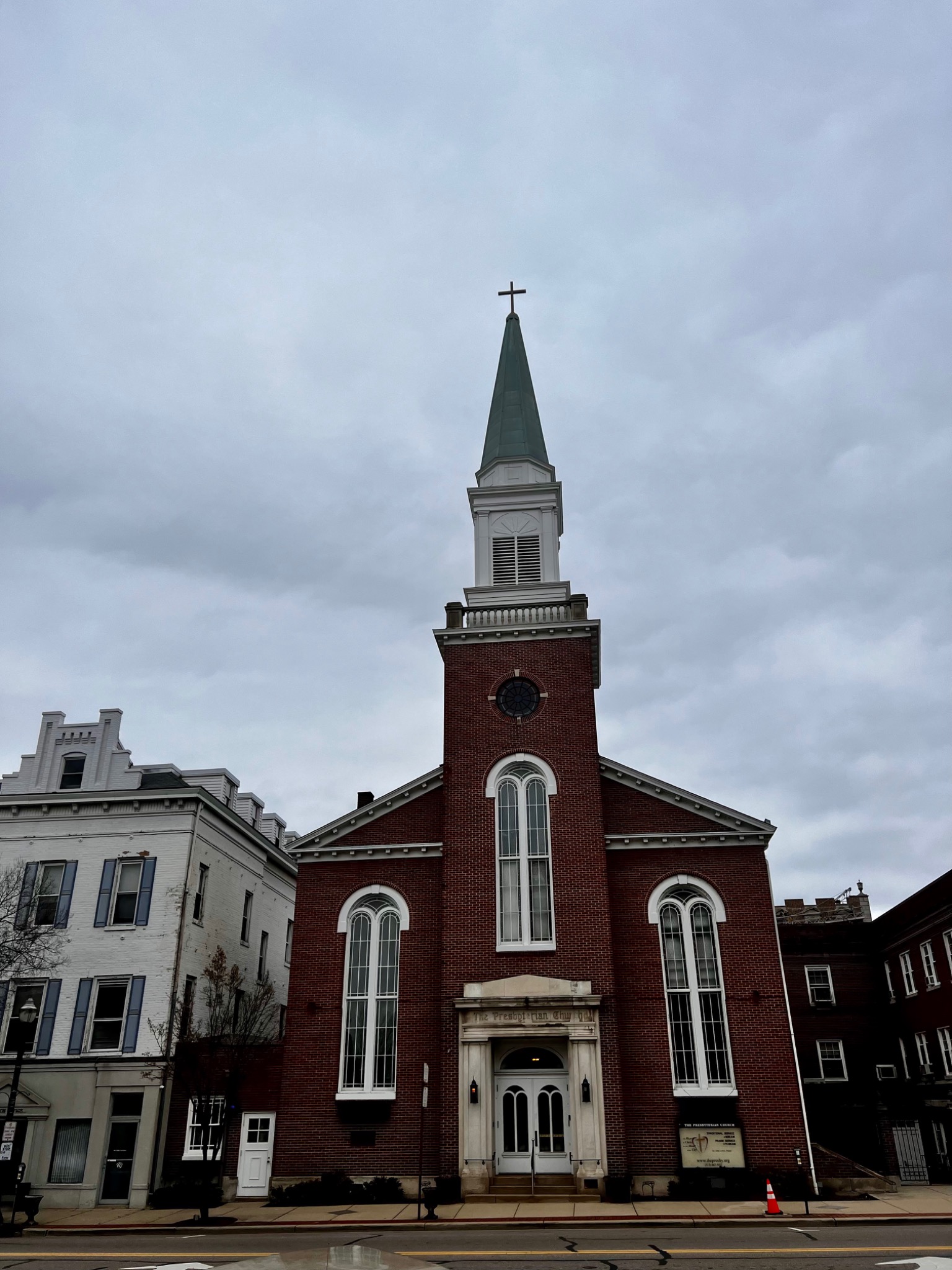
The historic Front Street church as it appears today. The present main structure was completed in 1855.
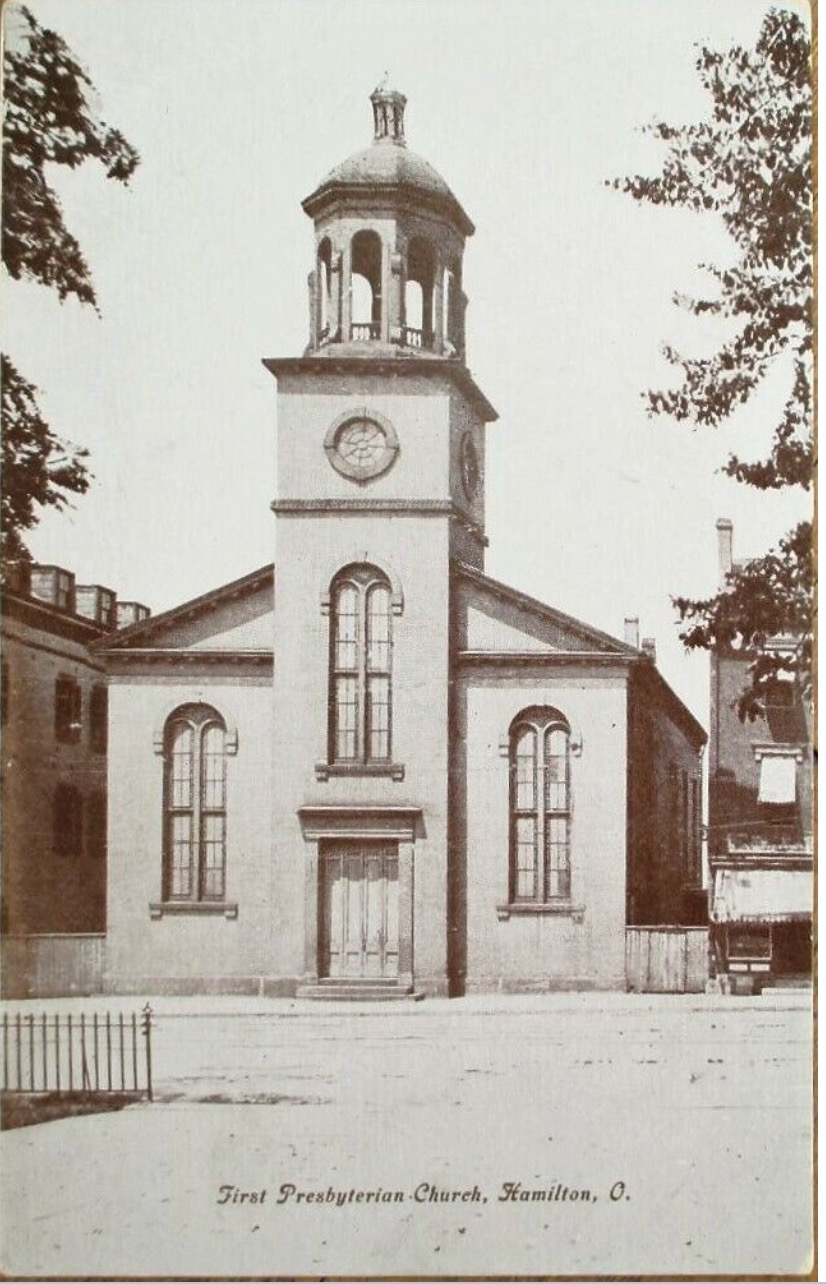
An early photographic view of the 1855 Front Street church. Exact postcard date and original publisher remain under review.
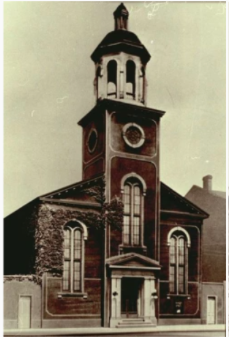
A later historic view showing an earlier tower and cupola configuration. Exact date and image provenance remain under review.
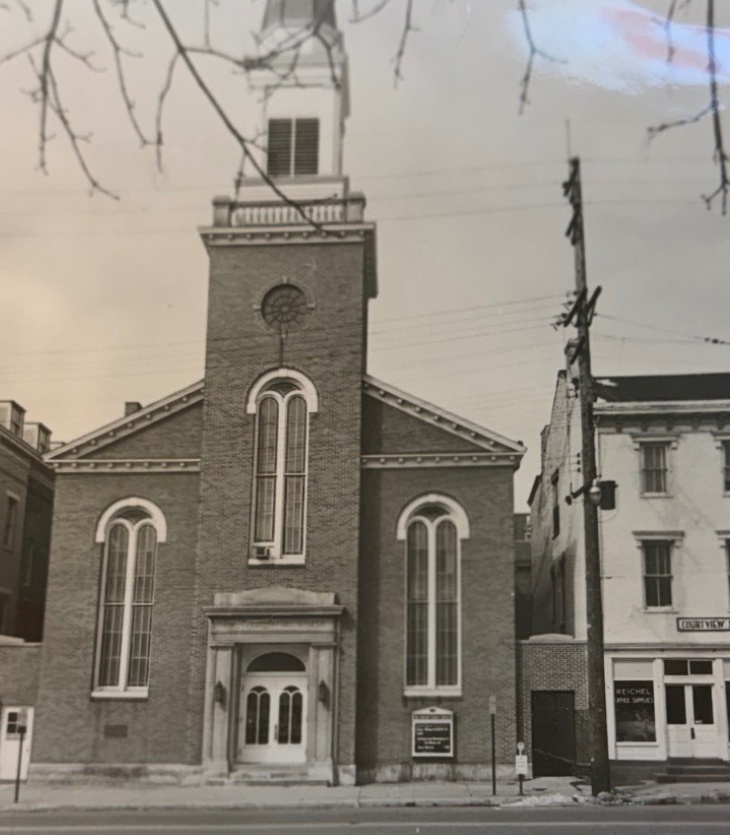
A cropped view from a church 150th-anniversary campaign photograph, focused on the church rather than the surrounding campaign sheet.
An institution inside Hamilton's antislavery network
Mark Campbell McMaken's 1895 reminiscence identified Hamilton's Presbyterian and Associate Reformed Presbyterian congregations as the churches in which the city's active antislavery people were concentrated. First Presbyterian's own records independently place several people important to this research within the congregation.
Rev. Thomas Ebenezer Thomas, a First Presbyterian minister, published his 1844 Review of the Rev. Dr. Junkin's Synodical Speech in Defence of American Slavery, a direct and substantial antislavery argument. Church records also connect several people who appear elsewhere in the Hamilton Underground Railroad research to this congregation, including figures in the legal, medical, civic, and Presbyterian networks.
The church standing during the Underground Railroad era
After earlier worship in the jointly owned Union Presbyterian Church and then a separate 1829 Front Street building, the congregation erected a new brick church on its present site opposite the courthouse in 1838. The building included a full basement divided into a schoolroom and other spaces. In 1842, Mrs. E. R. Thomas advertised her Select School in the "basement story of the Presbyterian Church," demonstrating active educational use of the lower level during the antebellum period.
Session minutes show the original church was still in use in 1854. A contemporary August 31, 1854 newspaper notice then reported that construction of the new Presbyterian church was underway and that the congregation was temporarily worshiping at Beckett's Hall.
A larger church rises on the same site
The congregation completed a larger church in 1855 on the same Front Street property. That building is the core of the church that survives today. Historic photographs show substantial exterior continuity while also documenting changes to the tower, cupola or steeple, entrance, and surrounding streetscape over time.
The building survived the catastrophic 1913 Great Flood. A flood-level marker remains on the church exterior, providing a physical reminder of how dramatically Hamilton's riverfront landscape and historic downtown were affected.
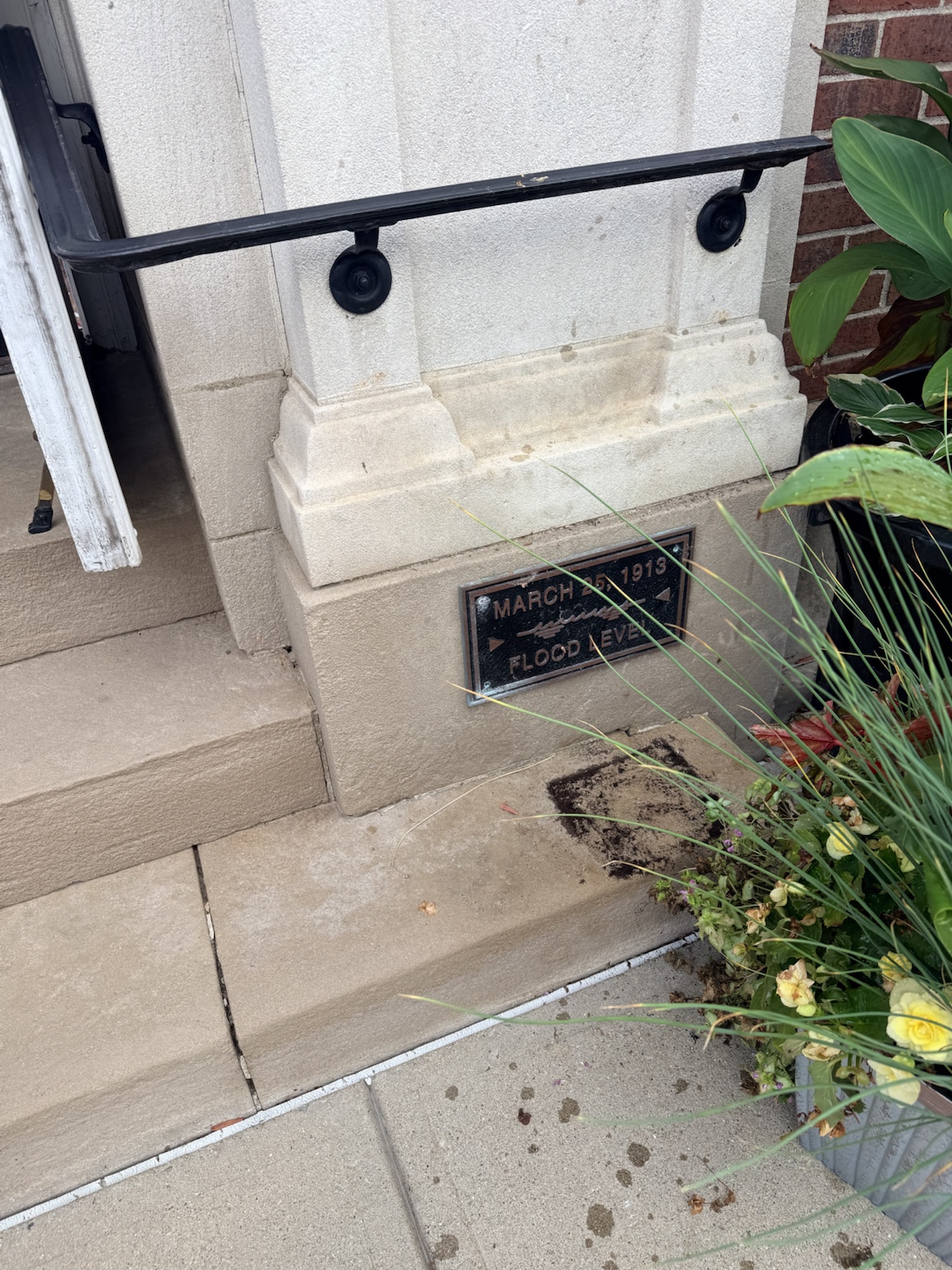
The surviving marker records the flood level at the church and helps explain why today's downtown landscape cannot be read as an unchanged antebellum streetscape.
Could fabric from the 1820 church survive?
Recent architectural exploration has raised an important question: whether portions of the 1838 church's basement, masonry, or stair circulation were retained when the larger church was built in 1855. The nineteenth-century building history describes the earlier basement, and modern observation suggests a later staircase may have been constructed above an earlier stair route.
This possibility is historically significant, but it remains under investigation. The website will not identify any concealed stair, wall, or basement feature as definitively dating to the Underground Railroad era until documentary or architectural evidence supports that conclusion.
More than two centuries on Front Street
Later histories preserve additional details
Two church-history manuscripts photographed at the Butler County Historical Society help reconstruct the congregation's institutional memory. They are later sources and are not treated as substitutes for contemporary session minutes, newspapers, or the 1876 published history.
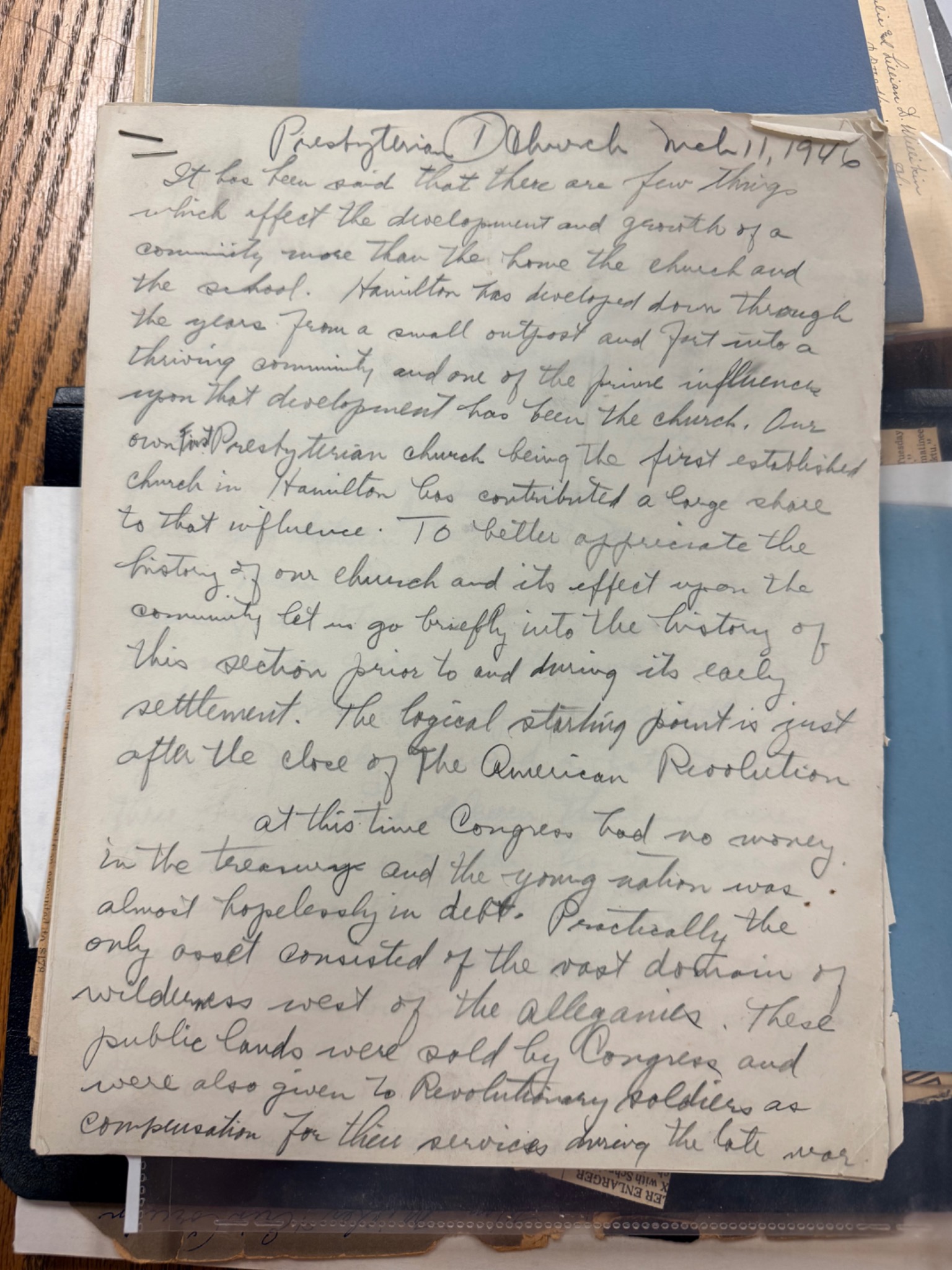
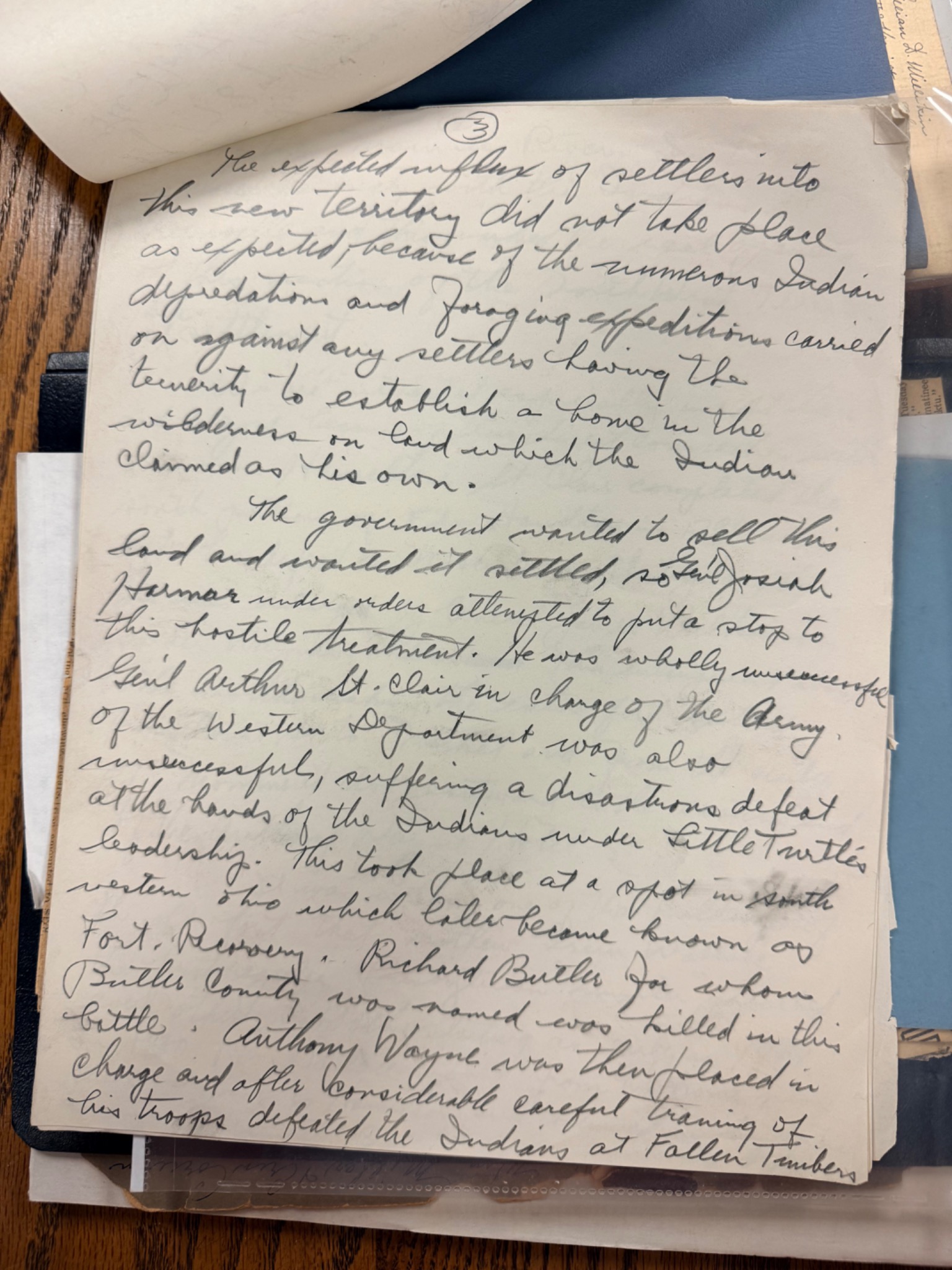
Marjorie Graeff history: Graeff's later history of the Presbyterian Church of Hamilton records that during the 1834-1835 revival period the congregation discussed and passed strong resolutions against slavery. This is useful institutional-history evidence that should be read alongside the earlier church and denominational records.